

In celebration of Liberation Day, let’s ponder Mike Lawler’s role in this moment.
This past week, the Center for Effective Lawmaking (CEL) released its “Legislative Effectiveness Scores” for the 118th Congress (2023-25). Mike Lawler would like you to know that he received the highest score of freshman lawmakers in the House, and 8th overall in Congress.
What does this mean? It means that Lawler introduced a whole lot of bills, and devoted lots of energy to promoting them and moving them into committee. As summarized in Lawler’s press release, he introduced 58 bills, with 7 passing the House and 1 becoming law. Additionally, 5 of his bills were incorporated into larger legislative packages that were signed into law.
CEL’s effectiveness score is “based on the combination of fifteen metrics capturing the bills that each member of Congress sponsors, how far they move through the lawmaking process, and how substantial their policy proposals are.” This is what the calculation looks like:
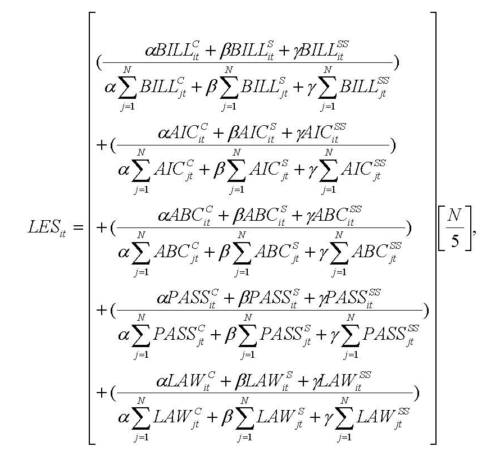
That will make your head spin. Should we be impressed that Lawler got a high score? Consider this statement in CEL’s FAQ:
Q: Is the sponsored legislation itself “effective”?
We are not able to answer this question, or related questions about the efficacy of the legislation that is being sponsored by members of the U.S. House of Representatives or Senate. Our methodology allows us to measure how effective Representatives and Senators are at moving their agenda items forward in the legislative process, but it cannot speak to any questions about the relative effectiveness of the bills that are proposed and/or the laws that are ultimately promulgated.
So Mike Lawler is more effective than most of his colleagues at moving his agenda forward. Colleagues who may be a bit less focused on running up the CEL score. What is Lawler’s legislative agenda? The one bill he introduced that was signed into law was the Enhanced Presidential Security Act of 2024, to enhance secret service protection for “major” Presidential and Vice Presidential candidates. This in the wake of the attempted assassination of Trump. And these are the 5 bills he introduced that were incorporated into other signed legislation:
- H.R. 3099, Special Envoy for the Abraham Accords Act
- H.R. 3774, Stop Harboring Iranian Petroleum (SHIP) Act
- H.R. 5923, Iran-China Energy Sanctions Act
- H.R. 7040, Undetectable Firearms Reauthorization Act
- H.R. 9437, Partners in Diplomacy Act
I’ll let you form your own opinion on whether these are truly impactful in the context of laws which already exist on these topics. And the many pressing challenges facing this country.
To take another example from this week’s headlines, Lawler is co-sponsor of a bill to allow proxy voting by House members who are new parents. Speaker Mike Johnson is opposed to the bill. Yesterday, Lawler voted with the Democrats and 8 other Republicans against Johnson on a procedural rule change that would have blocked the bill. Bold, effective, urgent? This is the bill where he takes a stand against his party leadership?
Back to the topic of Liberation Day, tariffs. Let’s remember that Mike Lawler voted in favor of the House rule change proclaiming that a day is not a day, effectively ceding Congressional power over tariffs to Trump for the remainder of this session of Congress. He and his GOP colleagues have also abdicated in a big way on the power of the purse. Very effective, but responsible? A bit more consequential than proxy voting in the House for new parents.
As the co-founder of CEL said in an interview, “We like to stay in our lane—it is not the ‘Center for Effective Oversight’ or ‘Center for Effective Communication with Constituents.’”
Happy Liberation Day.
Postscript
A good place to track legislation introduced by Lawler, and how he runs up his CEL score, is govtrack.us. There, for example, you will see that he has introduced 18 bills so far this year, and only 2 have a prognosis over 20% — bills to rename 2 post offices in his district.

